Choosing the best Composite Curing Oven is essential for optimal performance in manufacturing processes. These ovens are crucial in curing composite materials, which have become vital in various industries. Selecting the right oven requires a deep understanding of your specific needs.
Several factors play a significant role in this decision. Temperature control, size, and energy efficiency are just a few examples. It's important to consider the type of composites you will be curing. Different materials may require different curing conditions, which influences your choice of oven.
Professional recommendations can guide you, but personal research is necessary. Explore multiple options and check user reviews. Reflect on your requirements and the oven's capabilities. This thoughtful approach will help you make an informed decision, ensuring your investment supports your production goals effectively.
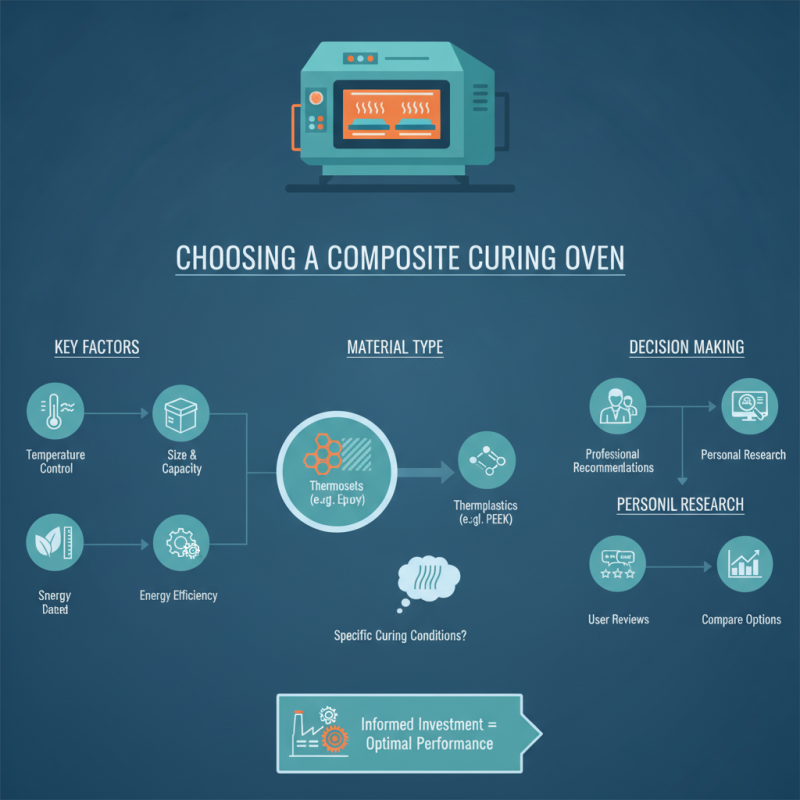
When selecting a composite curing oven, several factors are crucial. Temperature uniformity is paramount. A study by Composites World highlights that temperature variations can lead to compromised materials. Ensuring your oven maintains a consistent temperature improves product quality.
Heating rates are also critical. According to research from the American Institute of Aeronautics and Astronautics, controlled heating minimizes thermal stress on composites. Look for ovens that offer adjustable heating profiles to accommodate different materials and thicknesses. This flexibility aids in optimizing curing cycles.
Another important factor is the oven size and load capacity. The Composites Manufacturing Report notes that oversized ovens can waste energy and increase costs. Conversely, a too-small oven can limit production capabilities. Balancing size and efficiency is essential. Choose an oven that aligns with your production scale and needs, while remaining mindful of operational costs. These decisions influence both product quality and manufacturing efficiency.
Choosing the right composite curing oven starts with understanding the different types available. Two commonly used types are batch ovens and continuous ovens. Batch ovens are ideal for small-scale production. They offer flexibility to cure various composite parts at different times. However, they may not be as efficient for large volumes. Continuous ovens, on the other hand, are designed for high-throughput manufacturing. They can streamline operations but might require a more substantial initial investment.
Another option worth considering is the microwave curing oven. These ovens provide a rapid curing process using microwave technology. They are efficient and can significantly reduce cycle times. However, consistency can be a concern. Sometimes, uneven heating may lead to quality variability in the cured composite. Users often need to monitor the process closely to avoid such issues.
Thermal curing ovens also play a critical role, offering consistent heat distribution. They are reliable for standard composite curing applications. Still, they may lack the speed of microwave options and need to be operated in a controlled environment. Each type has its pros and cons, and careful consideration of your specific needs is crucial. Balancing efficiency, cost, and quality ensures you select the best oven for your composite curing requirements.
| Type of Oven | Temperature Range | Vacuum Capability | Size | Typical Applications |
|---|---|---|---|---|
| Batch Oven | Up to 350°F (175°C) | No | Varies, Typically Medium | General composite curing |
| Vacuum Oven | Up to 400°F (204°C) | Yes | Small to Medium | High-quality composites |
| Autoclave | Up to 750°F (399°C) | Yes | Large | Aerospace components |
| Convection Oven | Up to 500°F (260°C) | No | Medium | General composite applications |
| Infrared Oven | Up to 600°F (316°C) | No | Small to Medium | Quick curing applications |
When selecting a composite curing oven, several key features stand out. Temperature control is essential. Accurate temperature management ensures quality curing. Reports indicate that even a slight variation can affect the strength of composite materials. This is where digital controllers become invaluable. They allow precise adjustments, enhancing the overall curing process.
Uniform heat distribution is another critical feature. Inconsistent temperatures can lead to weak spots in the cured product. A 2022 industry study showed that nearly 30% of curing failures were due to poor thermal consistency. Look for ovens that utilize advanced fan systems for even airflow. These systems reduce hot and cold spots, promoting better results.
Consider the size and capacity of the oven too. An adequately sized oven helps maintain optimal conditions for larger batches. However, larger doesn't always mean better. Overloading can lead to inadequate curing. A balance must be struck between capacity and the specific applications you intend to use. Regular evaluations of your current and future needs aid in choosing the best model.
Curing composite materials is a critical process in manufacturing. It involves applying heat to resin systems, allowing them to harden and develop their final properties. Understanding this process ensures quality in composite products. Temperature control is vital. Too high, and the material may deform. Too low, and it may not cure properly, resulting in weak structures.
The curing time can vary based on the system used. Some materials require hours, while others may only need minutes. Monitoring the environment is equally important. Factors like humidity and air circulation can influence the curing outcome. These details may seem minor, but they play a significant role in the final product's integrity.
Selecting the right curing oven depends on your specific needs. Consider the size of your composites and the required temperature range. It’s essential to evaluate whether your oven provides uniform heat distribution. Inconsistencies can lead to imperfections. When investing in equipment, think about your operational requirements and future needs. Ensuring that you have room for growth can prevent costly mistakes down the line.
Budgeting for a composite curing oven is crucial for any organization. The initial cost can vary significantly. A quality oven may range from $15,000 to $50,000, depending on size and features. Industry reports show that manufacturers often underestimate these expenses. They often forget about installation or maintenance.
Maintenance costs should also be part of your planning. Regular servicing can add up over time. Estimates suggest that maintenance can account for 10-15% of the total oven cost annually. This figure surprises many buyers. Additionally, consider energy consumption. Average operational costs can impact your total budget, sometimes adding thousands annually.
It’s essential to list all features you need. For instance, temperature control, safety features, and energy efficiency could impact both purchase and operational costs. Balancing these features with your budget can be challenging. You might find cheaper options that fail to meet your initial criteria. Reflecting on long-term goals is essential. Being too focused on initial prices can lead to costly mistakes down the line.
: Temperature uniformity ensures consistent material quality. Variations can compromise the integrity of the composites.
Controlled heating minimizes thermal stress on composites, enhancing the quality of the final product.
Balance size with energy efficiency. Oversized ovens waste energy, while too-small ovens limit production capacity.
Batch ovens are flexible for small-scale production but may be inefficient for high volumes.
Microwave curing is fast but can produce uneven heating, leading to quality variability in cured composites.
Initial costs vary widely. Many buyers overlook installation and maintenance expenses, which can add up significantly.
Maintenance can account for 10-15% of total oven costs annually, often surprising many buyers.
Energy consumption impacts operational costs, sometimes adding thousands annually to your budget.
List all necessary features like temperature control. Cheaper options might not fulfill essential criteria.
Overemphasizing initial costs can lead to regrettable decisions and higher expenses later on.
When selecting the right Composite Curing Oven, there are several key factors to consider to ensure it meets your specific needs. It's essential to understand the different types of curing ovens available, as each type may cater to various curing processes and material specifications. Key features such as temperature uniformity, chamber size, and control systems play a crucial role in achieving optimal curing results for composite materials. Additionally, understanding the curing process itself will help you make a more informed decision, ensuring that your selected oven supports the chemical and physical requirements of the composites you are working with.
Budgeting is another critical aspect when investing in a Composite Curing Oven. By assessing both the initial costs and long-term operational expenses, you can find a solution that provides the best value for your investment. Taking all these factors into account will ultimately lead to a more effective and efficient curing operation, enhancing the overall quality of your composite products.
XUD Ovens