Choosing Electric Motor Industrial Process Ovens requires more than comparing temperature ratings and purchase prices. The correct oven must match the motor’s insulation system, varnish, bearings, winding geometry, and production volume. A mismatch can cause uneven curing, trapped moisture, or premature insulation failure. The workshop floor often reveals these problems first: uneven color, soft varnish, or a motor that runs hotter than expected.
Dr. Arun S. Mujumdar, a recognized drying-technology expert, has stated, “Drying is one of the most energy-intensive operations in industry.” His observation matters when evaluating oven efficiency. Airflow design, heat recovery, insulation quality, and precise controls can reduce wasted energy. Ask suppliers for temperature-uniformity data, not only maximum temperature claims. Check whether the oven maintains stable conditions near the door, corners, and loading zones.
A reliable selection process also examines chamber size, conveyor access, exhaust capacity, and maintenance space. Electric motors may need different curing profiles, so programmable controls are valuable. Overheating should trigger an alarm or automatic shutdown. That detail protects equipment and production schedules. Do not overlook cleaning. Varnish residue and dust can reduce airflow over time.
No selection is perfect. A larger oven may offer flexibility but waste energy during small batches. A cheaper model may appear practical but lack dependable sensors. I would not choose from a brochure alone. Request a sample load test, review service records, and involve operators who understand daily production pressures. The best Electric Motor Industrial Process Ovens balance process accuracy, safety, energy use, and long-term maintainability.
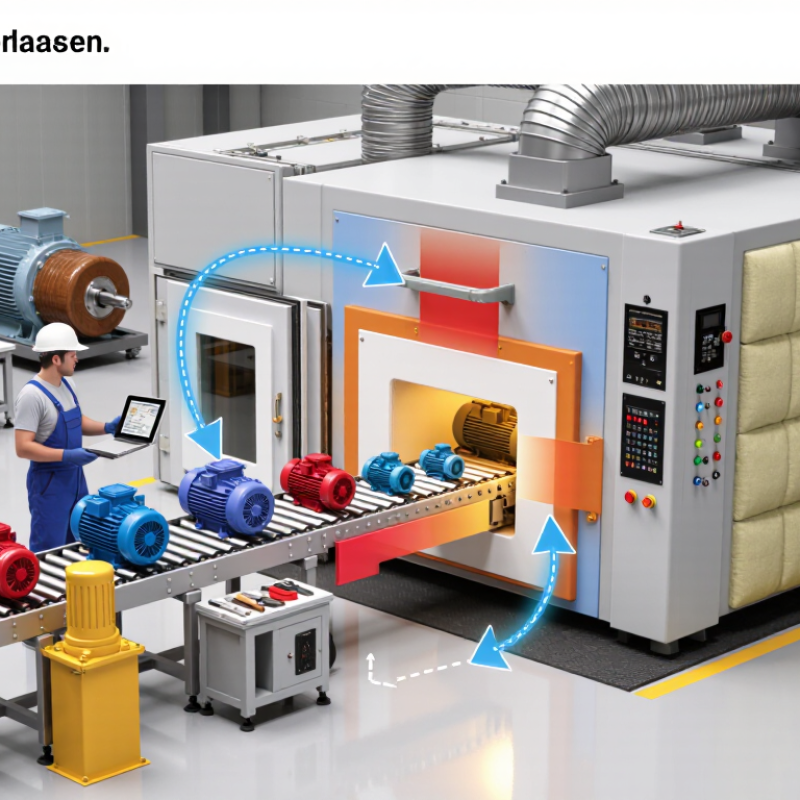
Choosing an electric-motor industrial process oven starts with the actual load, not just the part’s name. Record each item’s dimensions, weight, material, and fixture arrangement. A tightly packed rack can block airflow, while a heavy metal assembly may heat much more slowly than a thin component. Small details matter. Include the number of parts per batch and any moisture or coatings that affect heating.
Define the required operating temperature and the acceptable range around it. A process needing 180°C within a narrow tolerance may require different controls and airflow than one with a broad temperature window. Consider where the temperature matters: the oven’s display, the air around the load, or the part itself. Measure the load. A probe placed on a representative part can reveal delays that chamber readings miss.
Throughput and heat-up time should reflect real production conditions. Specify batches per hour or parts per shift, then account for loading, unloading, and hold time. Ask how long a fully loaded oven takes to reach the required part temperature, not merely its empty-chamber setpoint. If a cold morning start is common, include it in the requirement. Estimates can be imperfect; validate them with a representative load before finalizing capacity.
Choosing an electric motor for an industrial process oven starts with duty, not horsepower alone. IEC 60034-1 S1 means continuous operation at a constant load until thermal equilibrium is reached. That definition fits an oven circulation fan running for hours, but only when airflow and resistance remain stable. Record actual current, shaft speed, ambient temperature, and restart frequency during production. Small details matter.
An S1 motor should be sized for the real load, with enough margin for startup and dirty filters. Excessive oversizing can reduce efficiency and power factor, while undersizing can cause thermal trips. Oven surroundings need attention. High air temperature can reduce allowable motor output, even when the nameplate rating appears adequate. Use the manufacturer’s derating data, suitable insulation, and protection against dust, moisture, and radiant heat. A remote-mounted motor may be safer than placing it beside the hot chamber.
IE3 and IE4 motors reduce electrical losses, but efficiency gains depend on operating point. Compare efficiency at the measured load, not only at full rated power. A variable-speed drive may improve savings when airflow changes, but it also requires compatible motor insulation and control settings. Check acceleration time, drive cooling, and low-speed temperature rise before approval. I have seen projects select IE4 too quickly, then discover that poor sizing erased much of the expected benefit. That assumption deserves a second review. Request test data, duty details, and installation limits from qualified suppliers, and document the final selection.
Match motor duty to IEC 60034-1 S1 continuous-duty requirements and select the applicable IE3 or IE4 efficiency class.
Reference comparison for selected four-pole, 50 Hz motor ratings based on nominal minimum efficiency values associated with IEC 60034-30-1 efficiency classes. S1 means the motor is designed for continuous operation at a constant load until thermal equilibrium is reached. Actual efficiency limits depend on rated output, pole count, frequency, voltage, and the applicable standard edition; verify the exact motor data sheet before specification.
For electric motor components, an oven rated from 200°F to 1,000°F (93°C–538°C) offers broad process flexibility. The maximum rating, however, should not drive the choice. Match the working range to the insulation, varnish, resin, or curing specification. A process near 250°F needs different control behavior than one near 900°F. Small differences matter.
Evaluate the oven with a representative load, not an empty chamber. Stators, rotors, and stacked parts can slow heat transfer and create uneven temperatures. Ask for temperature-uniformity data at your intended setpoint and load. Check airflow, sensor placement, and recovery time after opening the door. A probe placed near the chamber wall may not reflect the temperature inside a tightly wound motor assembly. Don’t guess.
At higher temperatures, confirm that the chamber materials, wiring, exhaust, and safety controls suit the process. Also consider ramp rate and dwell time; reaching the setpoint quickly does not prove the part has heated evenly. Operators can focus too heavily on peak temperature. That is understandable, but a spreadsheet alone may miss how tightly packed parts heat in daily production. Trial runs and recorded measurements can expose that gap before the oven becomes part of routine work.
For an electric-motor industrial process oven, size airflow around the work, not just the chamber volume. ASHRAE’s Handbook—Fundamentals uses the sensible-heat relation 1.08 × CFM × temperature rise in Btu/h for standard air. At 1,000 CFM and a 100°F rise, that is about 108,000 Btu/h, or 31.6 kW. The estimate changes with air density and site conditions. Recirculation flow and fresh-air exhaust are not interchangeable.
Then build the heater load from the product, fixtures, enclosure, and air leaving the oven. NIST Special Publication 811 gives the conversion of 1 kW to about 3,412 Btu/h. Estimate wall and roof loss from area, insulation performance, and temperature difference; include door openings and exhaust makeup air. The U.S. Department of Energy’s Process Heating Assessment and Survey Tool treats these losses as measurable parts of process-heating performance. Small openings matter.
A first pass is rarely perfect. Check the estimate against a loaded warm-up test, logging chamber temperature, airflow, and electrical demand. If a conveyor enters cold, its mass can dominate the initial heating load. A handheld airflow reading may miss uneven circulation near racks or corners. Leave capacity for recovery, but avoid oversizing blindly: oversized heaters can cycle frequently and create temperature swings. Use the oven’s actual insulation data and the production recipe before finalizing kW.
When choosing an electric motor industrial process oven, verify NFPA 86 before comparing heating capacity. The standard addresses ovens, furnaces, fuel systems, ventilation, and safety controls. Its requirements can affect purge timing, airflow proving, ignition safeguards, and emergency shutdown logic. In 2022, NFPA reported 1,504,500 fires and approximately $18.1 billion in direct property damage in the United States. That figure makes weak protection difficult to justify.
The control panel should be evaluated against UL 508A requirements for industrial control panels. Confirm short-circuit current ratings, conductor spacing, grounding, enclosure construction, and documented component compatibility. Ask for test records, not only a compliance label. A motor can appear correctly sized while its starter, wiring, or disconnect remains under-rated. That happens more often than specifications suggest.
IP ratings under IEC 60529 should match the oven room, not the sales drawing. IP54 may resist limited dust and splashing, while IP65 provides stronger dust protection and water-jet resistance. Consider washdown pressure, condensate, powder residue, and cable-gland sealing. Overtemperature protection needs independent temperature sensing, manual reset, and a hardwired shutdown path where risk assessment requires it. The U.S. Department of Energy’s Industrial Motor Systems Market Assessment estimates motor-driven equipment uses about 68% of industrial electricity. Efficient motors matter, but a failed sensor can matter more. I would still question any design relying on one temperature probe. Redundancy costs space and wiring. It can prevent a small control fault from becoming a major thermal event.
Sources: NFPA, Fire Loss in the United States, 2022; U.S. Department of Energy, Industrial Motor Systems Market Assessment.
| Selection dimension | What to verify | Practical acceptance evidence | Why it matters |
|---|---|---|---|
| Process and load requirements | Define the required operating temperature, temperature uniformity, heat-up time, load dimensions, product mass, and production duty cycle. | A written process specification and a documented temperature-uniformity test using the intended load or a representative test load. | Oven capacity and temperature performance should be matched to the actual process, not just the chamber’s maximum temperature. |
| NFPA 86 applicability | Confirm whether NFPA 86 applies to the oven and process, identify the edition adopted for the installation, and review applicable requirements with the authority having jurisdiction (AHJ). | A project-specific compliance review that identifies the applicable edition, relevant provisions, required safeguards, and any AHJ conditions. | NFPA 86 addresses safety for industrial ovens and furnaces. Applicable provisions depend on the equipment, process, and locally adopted requirements. |
| UL 508A control panel | Check whether the industrial control panel is built and labeled in accordance with UL 508A where required. Verify the panel’s voltage, available fault-current rating, and enclosure details against the installation. | Panel documentation and label information, including the short-circuit current rating (SCCR), reviewed against the site’s electrical supply and applicable electrical code. | UL 508A covers industrial control panels; a panel label alone does not establish that the complete oven or process installation complies with every applicable requirement. |
| IP rating and enclosure location | Select an enclosure rating suited to the actual exposure to dust, water, washdown, and other environmental conditions. Verify that the rating applies to the complete enclosure as installed. | The enclosure’s documented IEC 60529 IP rating and confirmation that cable entries, doors, and installed accessories preserve the required protection. | For example, IP54 indicates dust protection and protection against water splashes; IP65 indicates dust-tight construction and protection against water jets. An IP rating does not by itself establish suitability for every washdown or hazardous location. |
| Independent overtemperature protection | Determine whether a separate temperature-limiting function is needed based on the process hazard review and applicable requirements. Verify its sensor, limit device, final switching element, and response to sensor or circuit faults. | A documented trip setpoint and cause-and-effect test showing that the protective function interrupts heat input when the limit is reached or a specified fault occurs. Confirm reset behavior and alarm indication. | A separate protective function can reduce the risk of overheating if the normal process controller, sensor, or switching device fails. The required design depends on the hazard assessment and applicable rules. |
| Motor and drive suitability | Check motor voltage, phase, rated speed, power, duty, insulation and ambient-temperature limits, cooling method, and compatibility with any variable-frequency drive. Consider the motor’s location relative to oven heat and airflow. | Motor nameplate and drive data, installation drawings, and confirmation that the motor remains within its specified operating limits for the expected load and environment. | Incorrect sizing or exposure to excessive ambient heat can contribute to overheating, reduced service life, or unreliable fan and conveyor operation. |
| Electrical supply and protection | Confirm supply voltage, phase, frequency, connected load, protective-device coordination, grounding, and disconnect requirements with the installation design. | Electrical drawings and equipment ratings reviewed by a qualified electrical professional against site conditions and applicable codes. | A correct match between the oven, motor, controls, and supply supports safe installation and dependable operation. |
| Commissioning and maintenance | Establish inspection and test intervals for temperature sensors, limit devices, alarms, contactors, interlocks, motors, and ventilation or circulation components. | Commissioning records, functional test results, maintenance instructions, and a process for documenting repairs and changes. | Periodic verification helps confirm that safety-related functions and process performance remain effective over the equipment’s service life. |
Note: Confirm applicable standards, editions, and installation requirements with the AHJ and qualified engineering professionals. An IP code describes enclosure ingress protection; it is not a complete measure of electrical or process safety.
Record each part’s dimensions, weight, material, and fixture layout. Note batch size, moisture, and coatings. A crowded rack can restrict airflow.
Test a fully loaded oven, not an empty chamber. Place a probe on a representative part and track its temperature. Chamber readings can be misleading.
Specify batches per hour or parts per shift. Include loading, unloading, and hold time. Cold starts matter too.
S1 means continuous operation at a constant load until thermal equilibrium. It may suit a circulation fan running for hours, if conditions stay stable.
Check measured current, speed, ambient temperature, and restart frequency. Allow for startup and dirty filters. Too much oversizing can also reduce efficiency.
Compare efficiency at the actual operating load, not only full rated power. A drive may help when airflow varies. Check low-speed cooling first.
Match the working range to the part’s insulation, varnish, resin, or curing requirements. A 200°F–1,000°F rating does not mean every process needs the highest setting.
Test representative parts and record temperatures at the intended setpoint. Check uniformity, airflow, and recovery after opening the door. Don’t guess. A single probe may miss cold spots.
Choosing Electric Motor Industrial Process Ovens begins with defining the process: identify the load, required temperature, production throughput, and acceptable heat-up time. These factors determine the oven’s capacity and help ensure that its motor and heating system can support both routine operation and peak demand. Match the motor’s duty to the application, checking for an appropriate IEC 60034-1 S1 continuous-duty rating and considering IE3 or IE4 efficiency to reduce energy use during extended operation.
Next, select a temperature range suited to the materials and process, such as 200°F to 1,000°F (93°C–538°C). Size airflow and heating power using required CFM, available kW, and estimated heat loss rather than relying on temperature alone. Before installation, verify relevant NFPA 86 and UL 508A requirements, confirm suitable IP ratings for the operating environment, and check that independent overtemperature protection is included. Together, these steps support safe, reliable, and efficient oven performance.

XUD Ovens