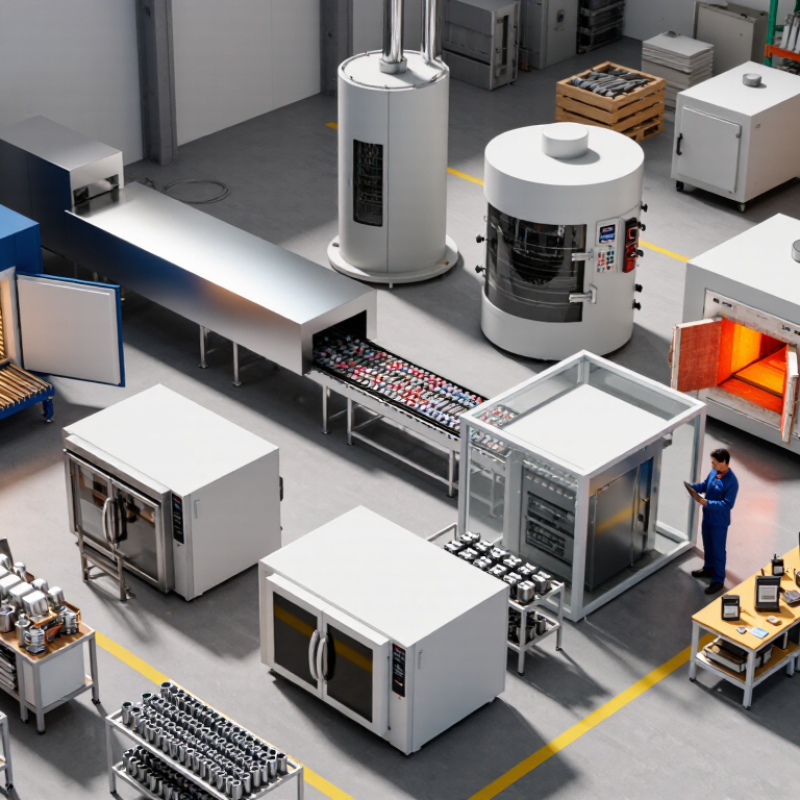
| Convection Oven |
Electric or gas-fired heaters warm the air, while fans circulate the heated air around the workload for relatively uniform heat transfer. |
Approximately 80–400°C |
Forced hot-air circulation |
- Powder coating and liquid paint curing
- Preheating metal parts
- Drying components, ceramics, and composites
- Heat treatment of general industrial parts
|
- Versatile and widely applicable
- Good temperature uniformity
- Suitable for batch or continuous production
|
Air movement can disturb lightweight powders or parts. Heat-up and cooling are generally slower than direct infrared heating. |
| Batch Oven |
Parts are loaded into a stationary insulated chamber. The entire batch is heated according to a programmed time and temperature cycle. |
Approximately 100–500°C |
Usually recirculated hot air; electric or gas heating |
- Powder coating of small and medium batches
- Adhesive and composite curing
- Stress relieving
- Drying and preheating irregularly shaped parts
|
- Flexible for different product sizes
- Lower initial cost than many conveyor systems
- Easy recipe changes between batches
|
Loading and unloading can require more labor. Production capacity depends on chamber size and cycle time. |
| Continuous Conveyor Oven |
Products travel through multiple controlled heating zones on a conveyor. Temperature, conveyor speed, and airflow are adjusted to create a repeatable process. |
Approximately 100–300°C |
Forced convection, infrared, or a combination of heating methods |
- High-volume powder coating
- Automotive and appliance components
- Fastener, wire, and metal-part processing
- Continuous adhesive curing
|
- High throughput
- Consistent residence time
- Easy integration with automated production lines
|
Requires a stable product flow and a relatively large installation area. It is less economical for frequently changing product sizes or very small batches. |
| Infrared Oven |
Infrared emitters radiate energy directly toward the product surface. The coating or material absorbs the radiation and heats rapidly. |
Approximately 100–600°C emitter temperature; product temperature depends on the process |
Short-wave, medium-wave, or long-wave infrared radiation |
- Rapid powder and paint curing
- Plastic and composite forming
- Surface drying
- Localized heating before forming or bonding
|
- Fast response and short heating cycles
- Can reduce the heated oven volume
- Useful for selective or zoned heating
|
Heating performance depends strongly on color, surface finish, material, distance, and line of sight. Complex geometries may heat unevenly. |
| Drying Oven |
Heated, controlled airflow removes moisture or solvents from a product. Exhaust ventilation carries vapor away from the chamber. |
Approximately 40–250°C |
Hot-air circulation with controlled exhaust |
- Water-based coating drying
- Moisture removal from powders and components
- Printing ink and textile drying
- Food, pharmaceutical, and chemical processing
|
- Improves coating and material quality
- Can use multiple airflow and exhaust zones
- Suitable for batch and continuous operation
|
Ventilation, solvent concentration, humidity, and exhaust treatment must be evaluated carefully, especially when flammable vapors are present. |
| Curing Oven |
Maintains a controlled temperature for a specified time so that coatings, resins, adhesives, or composites complete their chemical or physical curing reaction. |
Approximately 120–250°C for many industrial coatings; process-specific |
Convection, infrared, or hybrid heating |
- Powder coating curing
- Liquid paint and e-coat curing
- Epoxy and adhesive curing
- Composite and electrical-component processing
|
- Improves hardness, adhesion, and durability
- Programmable temperature and dwell time
- Can be designed for uniform heating of complex loads
|
Correct metal temperature and sufficient dwell time are essential. Excessive heat can damage substrates, coatings, adhesives, or electronic components. |
| Annealing Oven |
Material is heated to a controlled temperature, held for a defined period, and cooled at a controlled rate to reduce internal stress or modify material properties. |
Approximately 300–1,100°C, depending on the material |
Controlled convection, radiant heating, or protective-atmosphere heating |
- Stress relieving of metal parts
- Softening and property adjustment of alloys
- Glass and ceramic processing
- Wire, tube, and fabricated-part treatment
|
- Controlled thermal cycles
- Can improve ductility and dimensional stability
- Suitable for batch or continuous production
|
Temperature uniformity and cooling control are critical. Oxidation may require an inert or controlled atmosphere. |
| Heat-Treatment Furnace |
Uses a programmed heating, soaking, quenching, or cooling sequence to change the microstructure and mechanical properties of metals or other heat-resistant materials. |
Approximately 500–1,300°C, depending on the treatment |
Electric or gas heating; air, inert gas, vacuum, or other controlled atmospheres |
- Hardening and tempering
- Normalizing and solution treatment
- Metal component production
- Tool, die, and engineering-material processing
|
- Precise control of metallurgical properties
- Supports demanding industrial specifications
- Can be integrated with quench and cooling systems
|
Requires accurate temperature measurement, process validation, and appropriate atmosphere control. Quenching systems need additional safety measures. |
| Vacuum Furnace |
Air is removed from the chamber before heating. Processing in a vacuum or partial pressure environment reduces oxidation and contamination. |
Approximately 600–2,000°C, depending on furnace design and material |
Radiant heating in a vacuum or controlled partial-pressure atmosphere |
- Tool steel and high-value alloy treatment
- Vacuum brazing
- Degassing and sintering
- Processing of reactive or oxidation-sensitive materials
|
- Clean surfaces with minimal oxidation
- Accurate thermal processing
- Suitable for high-value precision parts
|
Equipment and operating costs are comparatively high. Load cleanliness, sealing, pumping capacity, and cooling design are important. |
| Cleanroom Oven |
Uses filtered air, controlled airflow, and sealed construction to limit particles and contamination during heating or drying. |
Approximately 50–300°C |
HEPA-filtered recirculated air or other controlled airflow |
- Electronic and semiconductor components
- Medical and pharmaceutical products
- Optical parts
- Laboratory and precision manufacturing
|
- Low-particle processing environment
- Good temperature uniformity
- Supports contamination-sensitive production
|
Filter maintenance, air-change requirements, material compatibility, and cleanroom classification must be specified before installation. |
| Explosion-Proof Oven |
Designed with engineered ventilation, electrical controls, and safety interlocks to process materials that may release flammable vapors or combustible solvents. |
Typically approximately 50–300°C, process-specific |
Controlled convection with monitored exhaust and safety systems |
- Solvent-based coating drying
- Paint and ink processing
- Adhesive and chemical-part drying
- Processes involving flammable vapor release
|
- Improved control of vapor hazards
- Dedicated exhaust and monitoring arrangements
- Suitable for regulated industrial processes
|
It must be designed according to the actual solvent, vapor concentration, airflow, electrical classification, and applicable local safety requirements. |
 XUD Ovens