Choosing among the best Composite Curing Oven manufacturers in China requires more than comparing prices. Buyers must examine temperature uniformity, vacuum performance, airflow design, insulation quality, and after-sales support. A reliable oven should maintain stable heat across the working chamber, even when large carbon-fiber panels occupy different zones. Small deviations can create resin-rich areas, voids, or uneven consolidation.
Dr. Stephen W. Tsai, a respected composites researcher, has emphasized, “A composite structure must be designed as a system, not as separate materials.” His principle also applies to curing equipment. The oven, tooling, resin system, sensors, and operating procedure must work together. A manufacturer with strong engineering experience should explain ramp rates, dwell times, cooling control, thermocouple placement, and data-recording accuracy. General promises are not enough.
This guide reviews Chinese manufacturers through practical and technical criteria. It considers factory experience, customization capability, pressure and temperature control, production testing, certification documentation, installation service, and long-term maintenance. Some suppliers may offer attractive quotations but limited process validation. That difference matters.
Real evaluation needs evidence. Ask for chamber temperature-mapping reports, sample curing records, reference projects, and clear warranty terms. Inspect weld quality, door sealing, controller interfaces, and spare-parts availability. A polished brochure cannot replace a witnessed factory test.
No ranking is perfect. Composite applications vary widely. Aerospace components, wind-turbine blades, automotive panels, and sporting goods demand different oven configurations. This article therefore highlights manufacturers that demonstrate dependable performance, transparent communication, and practical customization. The final decision should follow verified requirements, not marketing language alone.
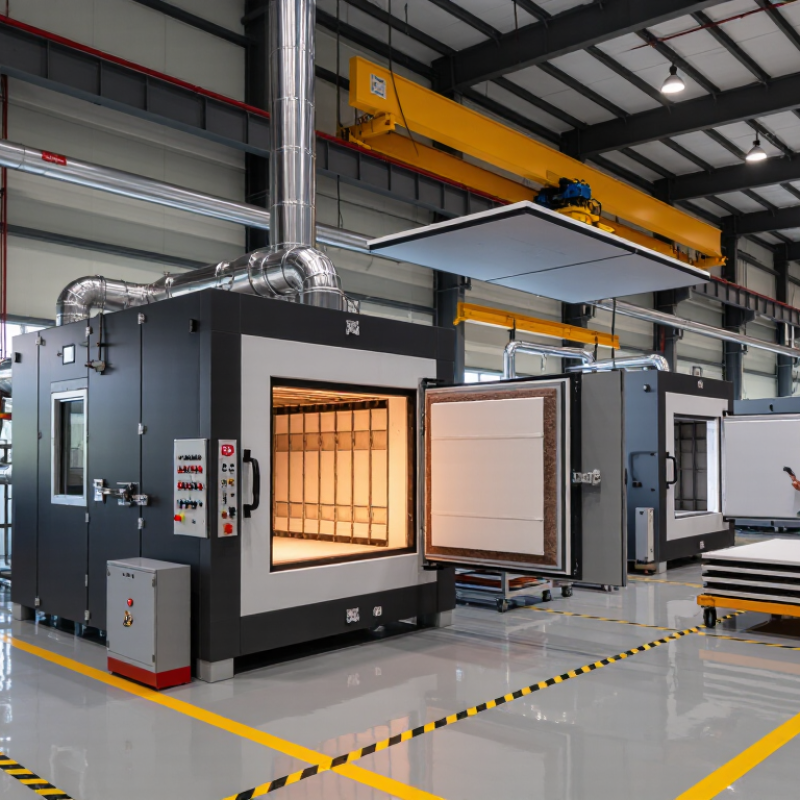
Composite curing ovens in China are commonly defined by their 60–200°C operating range and controlled airflow. This range supports many resin systems, prepregs, adhesives, and post-cure processes. A 60°C setting is not automatically gentle. Uneven heating can still create soft zones, residual stress, or inconsistent bonding.
Experienced manufacturers should provide temperature uniformity data, airflow diagrams, and calibrated sensor records. During a factory inspection, check the chamber at several points, including corners and the door area. A reliable oven should maintain stable air circulation after loading, not only when empty. Horizontal airflow can suit flat panels, while vertical circulation may work better for stacked components.
Ask how the system manages fresh-air intake, exhaust, and recirculation. Excessive exhaust wastes heat. Weak circulation extends curing time. Control accuracy also matters near 200°C, where insulation quality becomes visible through surface temperature and energy consumption. Some suppliers advertise wide temperature ranges but provide limited proof at both extremes. That deserves careful questioning.
Review heater layout, fan protection, alarm functions, and emergency shutdown design. Request a sample curing record from a similar composite application. Site acceptance testing should compare multiple calibrated probes with the controller display. Small gaps may appear around the door seal. They should be measured, not ignored. A strong manufacturer also explains maintenance intervals, spare-part availability, and operator training in practical terms.
Request recent temperature uniformity survey files and calibration certificates. The data should cover the entire qualified working zone. Center-point testing is not enough. Raw records reveal more than brochures.
It means temperatures stay within three degrees across tested chamber positions. Ask about load weight, ramp rate, sensor tolerance, and survey duration. A result at 180°C may not match 120°C or 200°C. The test boundary matters.
Request the CE declaration and current ISO 9001 certification. Check that both documents match the factory and oven model. Also request wiring diagrams and calibration records. A certificate alone proves little.
Rank suppliers by evidence, not advertised heating ranges. Stronger suppliers use documented procedures and third-party calibration. Some provide ±3°C results only with light loads. Others list uniformity without defining test conditions. That difference matters.
A FAT should record heating curves, alarm checks, and door-seal inspection. Watch a complete heating cycle. Do not accept only a polished demonstration. The test may still miss production problems.
A SAT should test the oven under your actual production conditions. Check loaded temperature uniformity, recovery after door opening, and alarm behavior. Verify recipes, sensors, and vacuum integration if required. Real production exposes weak assumptions.
Confirm warranty length, spare-part responsibility, response times, and remote support. Ask about local engineers, training, language support, and emergency parts delivery. Verbal promises are easy to forget. Keep every approval in writing.
A visit is useful when practical. Watch operators complete one full heating cycle. Inspect fans, seals, wiring, and software screens. Ask operators for honest feedback. I might still miss something.
Choosing the best Composite Curing Oven manufacturer in China requires evaluating more than heating performance. This guide explains how ovens operating between 60°C and 200°C use controlled airflow to achieve stable curing for FRP and other composite components. Manufacturers are compared according to AMS 2750 compliance, temperature uniformity of approximately ±3°C, airflow control from 0.5 to 2.0 m/s, energy efficiency, and their ability to support continuous 24/7 production.
The article also compares batch, continuous, and autoclave-free systems, helping buyers select equipment based on part size, production volume, and process requirements. Important purchasing checks include CE marking, ISO 9001 certification, warranty coverage, factory acceptance testing (FAT), site acceptance testing (SAT), installation support, training, spare parts, and international service capability. By reviewing these technical, operational, and support factors together, manufacturers can identify a reliable curing solution that balances product quality, operating cost, scalability, and long-term production stability.

 XUD Ovens